If you are picking flights for Día de Muertos, the question comes up fast: is it Nov. 1 or Nov. 2? The answer is both. The recurring observance spans Nov. 1 and 2, and each day has its own name and purpose.
Once you know what each date means, an event listing is easier to read. Public festivals are scheduled by their organizers, while families and towns keep calendars of their own.
Two days, two names
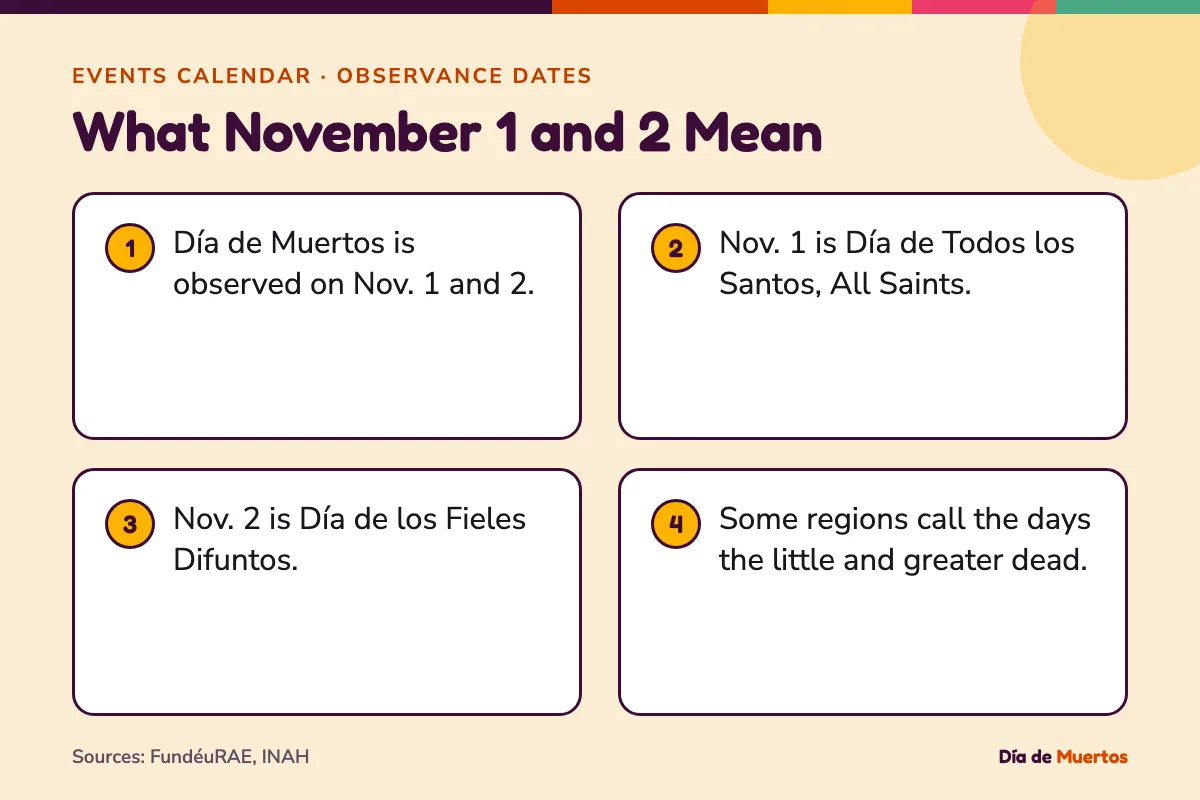
In Spanish, the first day is Día de Todos los Santos, All Saints' Day. The second is Día de los Fieles Difuntos, the Day of the Faithful Departed. In Mexico the pair of days together is called Día de Muertos, and the "los" is optional, so Día de los Muertos is also correct.
Spanish spelling rules put a capital letter on the main words of a holiday name, whether it is civic, military or religious. That is why you will see the names written with capitals in careful Spanish writing, even though newspapers sometimes lowercase them.
What each date commemorates
In the Catholic calendar, Nov. 1 honors all saints, including unnamed Christian martyrs. The observance brings their commemoration together on a shared feast day.
Nov. 2 commemorates the faithful departed. In the Catholic belief described by the archaeologist, these souls rest in Christ but have not yet reached heaven, and the living pray to help them attain salvation. His historical account also describes masses carrying a plenary indulgence for souls in purgatory.
In the archaeologist's chronology, Pope Gregory IV established the November feast of All Saints around 835. Spanish Dominican priests later introduced the practice of celebrating three masses for the faithful departed in the late 15th century.
One interpretation of where the dates come from
The archaeologist locates the origins of these observances in medieval Europe and credits their institution to the Catholic Church. In his view they should not be confused with older Mesoamerican funerary practices, which had other features and fell on other dates.
He places their arrival in Mexico after the Spanish conquest, with celebrations in early churches founded by Franciscans in Texcoco, Tlaxcala and Mexico City. He also disagrees with authors who tie the modern holiday closely to pre-Hispanic ceremonies. His distinction concerns the origins of the church observances, rather than a single account of every family's remembrance today.
The little dead and the greater dead
The same essay mentions a naming habit that varies from place to place. In some parts of Mexico, the November festivities are known as the day of the "muertos pequeños" and the day of the "muertos mayores," the little dead and the greater dead.
In some parts of Mexico, Nov. 1 is associated with deceased children and Nov. 2 with deceased adults. These associations sit alongside the church names rather than replacing them everywhere. Community calendars differ; the distinction is not a nationwide timetable.
The archaeologist describes evangelization as an uneven process across populations with different cultures and religions. A village's own sequence of days is the one that counts in that village.
Home calendars and festival calendars
A colonial account describes households preparing offerings and lighting candles at night, including in neighborhoods without resident church ministers. It records remembrance taking place at home as well as through church services.
The archaeologist distinguishes the Catholic observances of All Saints and the Faithful Departed from the festivities surrounding them. He describes continuity in the church observances but change in the wider celebrations. Drawing on historian Elsa Malvido's interpretation, he describes a reinvention during the Cárdenas era, from 1934 to 1940, with a secular, nationalist purpose.
That helps explain why a public parade or museum show can be a different thing from a family's remembrance. A civic event is scheduled by whoever runs it. It may cluster around Nov. 1 and 2, but its listing tells you about that event.
Before you go
Use Nov. 1 and 2 as the anchor dates, then look for the dated public program of the city, state or venue you plan to visit. Check hours before you book, because a listing sets the times for that event only.
Family remembrance can be private, including at cemeteries; visitors are guests and may be told no. A public program is a starting point for planning, not permission to enter a home or join remembrance at a family's grave.
Ask before you photograph anyone, keep off the graves and leave the flash off. If a family or a town marks different days from the ones above, follow its lead.
Questions readers ask
Is Día de Muertos on Nov. 1 or Nov. 2?
Whom does Nov. 2 commemorate in the Catholic calendar?
Do all communities follow the same schedule?
Sources