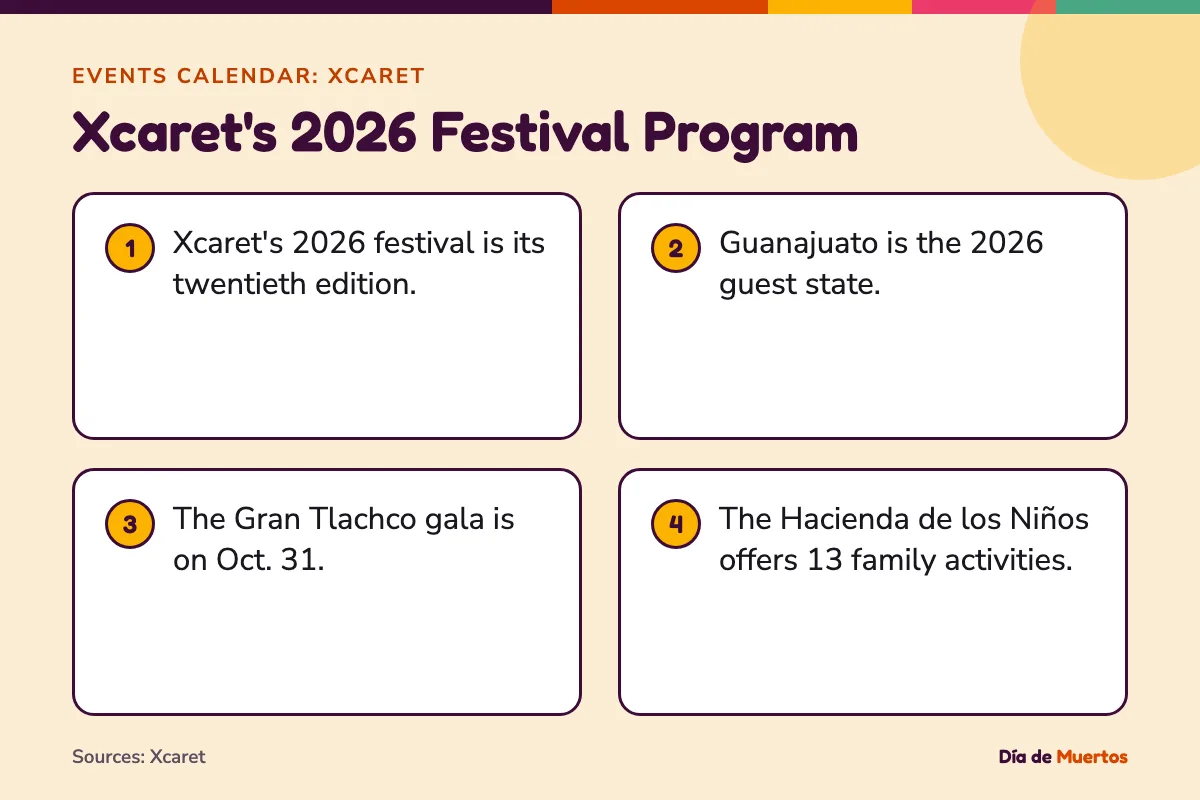
Choosing a day at Xcaret's Festival of Life and Death comes down to one question: are you going for the gala concert, or for the program as a whole? Xcaret's announcement dates the gala for Oct. 31, 2026, and describes a four-day arts program alongside altars, workshops and food.
This is the festival's twentieth edition, and Guanajuato is the guest state. It is a program organized by the park, a showcase of regional performance and cooking. Its staged presentations are distinct from family observances.
Oct. 31, 2026: the gala
The festival's Gala Concert is scheduled for Oct. 31, 2026, at the Gran Tlachco. Pandora and Flans bring a special version of their +Inesperado Tour, a meeting of two women's groups whose songs have been part of several generations' lives.
This announcement gives no gala start time, individual schedules for the other performances, or admission-by-admission breakdown of inclusions. The gala has its own ticket link on the festival page.
The festival around the gala
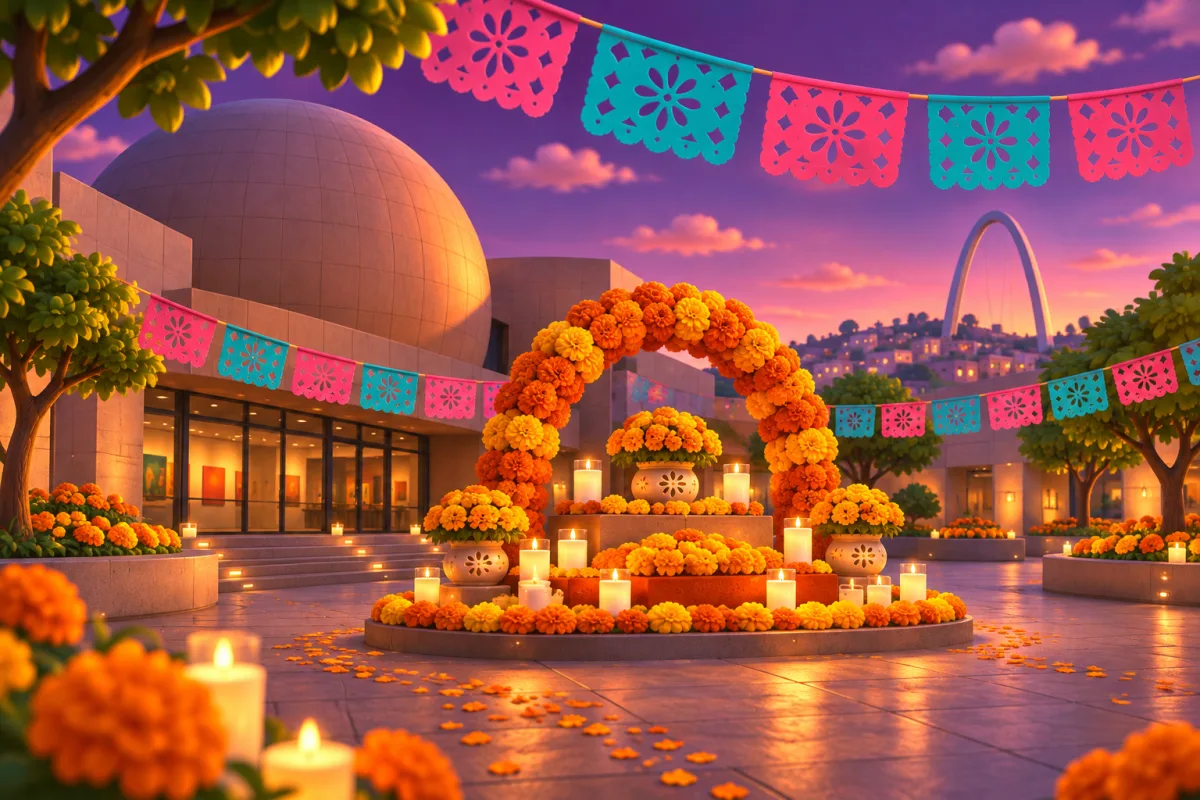
Xcaret says most of the program happens inside the park, where plazas, paths and corners become stages. Altars, theater, concerts, dance, workshops, crafts, agro-industrial products and food gatherings all share that space. The celebration also reaches the Xcaret hotels.
An opening ceremony starts the twentieth edition. Over four days, the arts program mixes regional stories, Guanajuato characters, dance, guided walks, workshops, exhibitions and music.
Theater and walking shows
The stage works lean toward humor. Yllana, a Spanish company with many awards, sends five odd singers into a recital that keeps slipping away from them. A comedy set at a wake follows a village full of secrets and a dead man who seems to have left a mess behind. In "Elefante," six residents of a nursing home chase an answer to one question about truth.
In "La Llegada de Polilla," a girl, her mother and a creature come to take her share a tender story about love and loss.
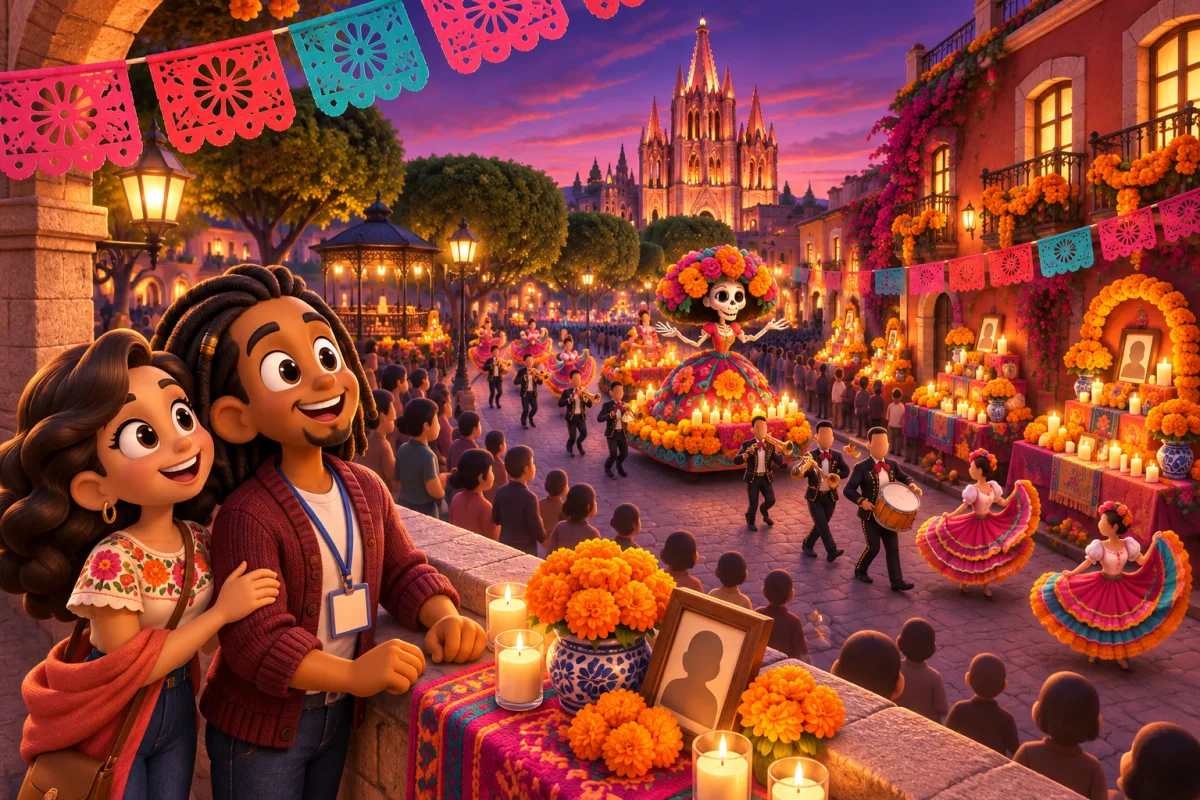
Guanajuato arrives as theater you walk through. In one staged tour, a catrina tells stories tied to the state's churches and legends. In another, monuments and landmarks come to life and speak. A third show has a mummy wake up in Guanajuato's depths and tell secrets, drawing on tunnels and oral tradition.
Music and dance
The music program meets Guanajuato's sounds with the traditions of the Yucatán Peninsula. Singer Lorenzo Negrete, from Guanajuato, joins Xcaret's Mariachi Monumental for "Serenata Para Las Almas," a tribute to songs that have followed Mexican families for generations.
The University of Guanajuato's folkloric ballet performs scenes that include "La Danza del Torito: Entre la Vida y la Muerte" and Huapango Arribeño. Las Palomitas Serranas, from the Sierra Gorda, are described as the first all-women group in that genre. Tali Díaz, from Xichú, brings Huapango Arribeño and Son Huasteco with Los Díaz del Real.
The Quintana Roo Folkloric Ensemble performs a tribute with the Real Orquesta Yucateca and the Jaranera Noh Beh. Operativo Kafka puts eight dancers on stage for a contemporary piece about the cycles of life. The Entremeses Cervantinos, short theater pieces that began in 1953 at the University of Guanajuato, also come to the festival.
Workshops, food and the children's area
One workshop covers two traditional dishes of Guanajuato, and another covers the Pan de Ánimas of Acámbaro, a bread that also serves as an offering. Eighteen traditional cooks from Guanajuato and Quintana Roo share dishes in a food showcase, among them mole verde, caldo capón, tamal de muerto, mucbipollo and cochinita pibil.
The crafts display includes ceramics, wood, leather, silver, papier-mâché, candle-making and tinwork. Muralist Alejandro Cortés, known as Boomzer, brings work on Guanajuato identity, and a photo exhibition honors the hands behind the crafts. In the Hacienda de los Niños, thirteen participatory activities are planned for families.
Festival and family remembrance
The Nov. 1 and 2 observances began in medieval Europe, set up by the Catholic Church for All Saints and the Faithful Departed. They are different from the ancestral death rites of Mesoamerica, which had other features and other dates.
Many older Indigenous beliefs continued after the conquest in Christianized forms, kept alive in communities through language and oral tradition. The historical account also describes families bringing offerings to graves and preparing food for the dead at home.
Before you go
Choose the gala if Pandora and Flans are the deciding attraction; the announcement supplies its date and venue. For theater, workshops or food activities, check the organizer's current program before choosing a day. Read the ticket conditions before paying, including whether the gala or another activity you want requires a separate purchase.
Family remembrance can be private. A festival admission is not permission to join a family observance: ask before joining or photographing people, and accept a no. Around altars, leave offerings undisturbed and give others room to remember.
Questions readers ask
Who will perform at the gala?
Where did the Catholic Nov. 1 and 2 feast days originate?
Is anything planned for children?
Sources