Planning a Día de los Muertos evening in San Francisco's Mission District starts with deciding which gathering you want to join. Its community altar gathering and street procession offer different ways to remember the dead.
At the altars, people leave offerings and messages. In the procession, dancers guide participants through the streets.
Two gatherings, one remembrance
Hundreds of people gathered in the Mission on a Monday night to remember people who had died. They came to honor family, friends and others they had lost.
The custom began in Mexico, but the wish to honor loved ones reaches well beyond one community. People of all backgrounds joined, whether they were walking in the procession or building altars.
"We are no longer strangers when we are choosing to celebrate together" (Deni Aguilera, Co-Director of Marigold Project SF)
Community-built ofrendas
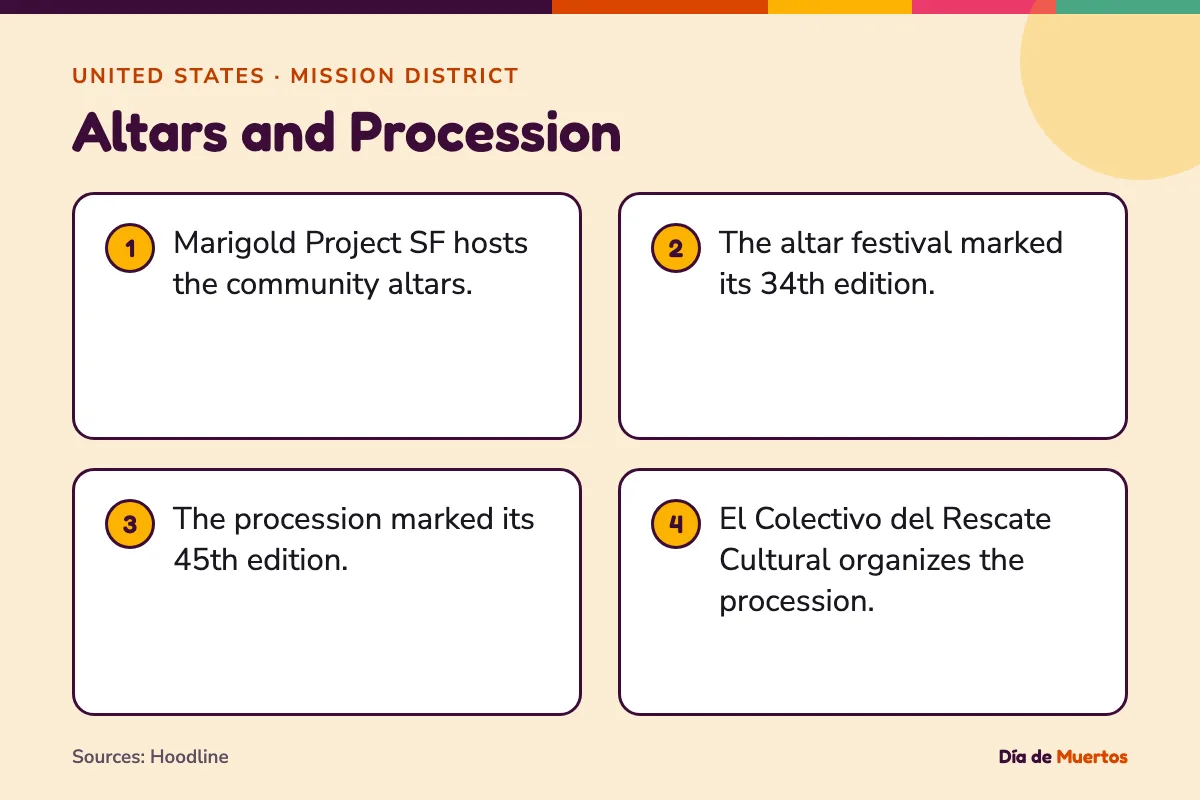
Potrero del Sol Park, also known locally as La Raza Park, hosted the 34th annual Festival of Altars. Marigold Project SF hosts its ofrendas, which community members create.
Individuals could reserve a space to build an altar of their own. They could also bring flowers or mementos to place on some of the community altars.
That edition's theme was "Familia: Entre Raíces y el Cielo", or "Family: Between Roots and Heaven." It looked at family as a living ecosystem and at families around the world facing displacement, separation and violence.
The altars covered many kinds of loss and love. A hillside altar remembered people lost to AIDS, and another honored people killed by ICE. Singers featured at another altar included Aretha Franklin and Dolly Parton. Schools and community groups contributed, too. Live Oak School's altar displayed calaveras; an altar representing East, created for Marigold Project, was hosted by The Mission Preparatory School.
One Mission resident built an altar for his mother, a teacher of blind and visually impaired children, who had recently died. His family had joined neighborhood Day of the Dead events nearly every year, and he said she would have wanted attention for everyone being honored.
People also wrote notes to the dead and pinned them up, including one for a dog. Candles and flowers, including marigolds, decorated the stage. Mariachi San Carlos performed in the park; one violinist played beneath an altar arch.
Deni Aguilera, co-director of Marigold Project SF, described the hope that anyone who walked in would feel like family. Those who choose to celebrate together, she said, stop being strangers.
The procession on 24th Street
El Colectivo del Rescate Cultural organized the 45th annual procession. Participants traveled up 24th Street.
The Azteca dance group Dazantes Aztecas Coyolxauhqu led the way. Its dancers performed ritual dances and cleansing and served as spiritual guides.
The tone is set at the start. The procession is a sacred cultural act of honoring the dead rather than a party, and the celebration follows afterward.
Along the route, a Catrina, the elegant female skeleton figure, walked 24th Street, and a Catrín, her male counterpart, rode a lowrider bicycle. These figures are a public, festive part of the tradition. Dancers also carried marigolds, flowers closely tied to the holiday.
Remembering people the community lost
The collective also remembered several recently deceased men with longstanding roles in the procession. They included former director Luis de la Garza and Ricardo "El Tigre" Peña, who ran a Mission shop and was an Azteca dancer.
Peña's dance group had led the procession every year. For the neighborhood, the evening was also a way to say goodbye to the people who had kept it going.
Getting around
Before setting out, check current Muni alerts and city street notices rather than relying on an old procession route. Allow extra time for the journey, including any walking between your transit stop and the gathering you plan to join.
Where the tradition comes from
In Mexico and much of Latin America, Día de los Muertos brings remembrance into homes and cemeteries. Families prepare ofrendas using photographs and candles, along with sweets and favorite dishes or drinks for departed relatives.
The rituals have an estimated history of about 3000 years, drawing on Mesoamerican traditions, including those of the Aztecs. Death belonged within the cycle of life in these traditions. Spanish arrivals later moved the observance to align with All Saints' Day and All Souls' Day; Indigenous practices and European religious traditions became intertwined.
The custom traveled with Mexican immigrants to the United States at least as far back as the 1890s. Family observances were often quiet and religious: attending Mass, tending graves with flowers and remembering relatives.
During the 1970s, artists and activists used the holiday to strengthen Chicano identity and reconnect with Indigenous heritage. An early example of the modern public celebration emerged in East Los Angeles in 1973. The printmaking collective Self Help Graphics & Art led it. Participants finished their parade at a cemetery altar remembering victims of gang violence.
Public observances organized by arts institutions and community groups have become more widespread in the United States. Alongside them, Mexican American families continue their own personal, sometimes religious observances. A public gathering is one expression of the tradition, not a replacement for family remembrance.
Before you go
The public gathering includes deeply personal remembrances: a mother's life, a recently lost dog and people mourned by the wider community. Photos and keepsakes on an altar may carry that family's grief. Ask before you photograph anyone, and don't touch or move offerings.
Add flowers or notes only where the hosts invite you to. For each year's plans, look to Marigold Project SF for the altars and to El Colectivo del Rescate Cultural for the procession.
Questions readers ask
Can visitors add something to the community altars?
How do the park altars and the procession differ?
Where do today's public celebrations come from?
Sources