

When choosing a destination for Día de Muertos, put the safety check alongside the festival search. Before committing to a place, look at what the official guidance says about both the destination and the journey. Mexico's country-wide advisory is only the beginning of that check.
The U.S. State Department's Mexico advisory needs to be read at several scales: national guidance, regional conditions and restrictions affecting particular areas. Use the national level as an introduction, not as a substitute for checking the places on your itinerary.
Everything below describes U.S. government assessments. If you hold another passport, read your own government's guidance as well.
Start with the country-wide level
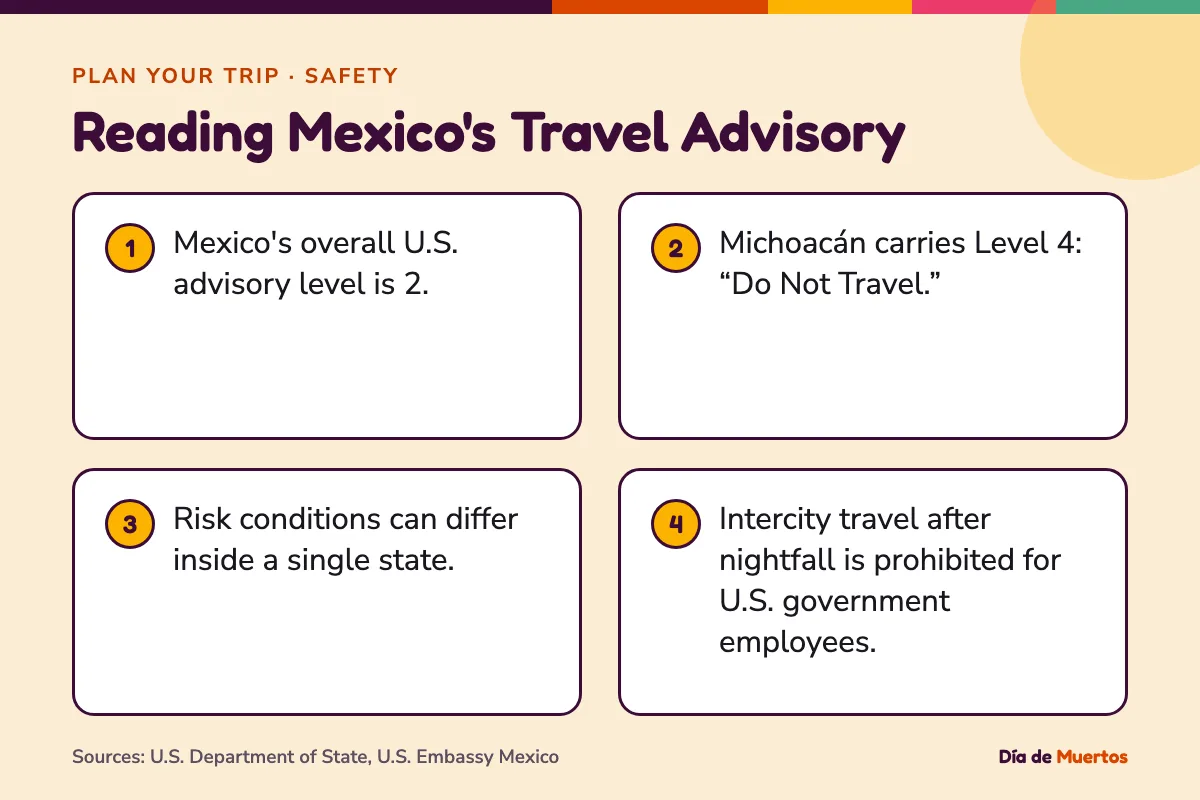
The State Department places Mexico at Level 2, “Exercise increased caution.” It gives three reasons: terrorism, crime and kidnapping. It also says that some areas have increased risk, which is the hint that one number cannot describe the whole country.
Level 2 is not an all-clear, and it is not the same as the warning attached to the most restricted places. It is the starting point, and the rest of the advisory is where the detail lives.
The risks it identifies include robbery and carjacking, as well as kidnapping, homicide and sexual assault. It also warns about terrorist violence. For further information on terrorism, the advisory directs readers to the State Department's country reports. These are national warnings, not a comparison of individual festival destinations.

Why a state's name is not enough
Conditions are not uniform across Mexico: the advisory describes differences between states and also inside their borders. A country-wide label therefore cannot answer every question about a particular town. Read beyond that label before deciding whether the guidance fits the trip you have in mind.
Some areas assessed as high risk are closed to travel by U.S. government employees. Those places can share a state with areas assessed as low risk. For planning purposes, that means a state's name alone is not enough: check whether a restriction covers the specific place you want to reach.
The advisory also warns that U.S. government assistance is constrained across many parts of the country. Weigh that warning alongside any festival program. An event listing is not an assessment of the assistance available if something goes wrong, and it should not be used as one.
Look up both ends of the trip
The advisory tells readers to check its maps of restricted areas. Use them twice: once for the place where the festival is held, and once for the places you would pass through to reach it.
That second check is easy to skip. A plan can look fine on paper at the destination and still involve a long ground journey, so the route deserves the same attention as the plaza at the end of it.
Emergency help is another consideration. The advisory warns that rural or remote locations may have only limited services, or none. If your itinerary takes you away from cities, weigh that warning before paying for the trip rather than treating it as a detail to resolve after arrival.
A worked example: Michoacán
Michoacán carries the U.S. advisory's Level 4 “Do Not Travel” designation. The U.S. Embassy in Mexico has announced plans to restart government activities across the state, but that operational announcement is not a change to the travel warning. Read the two statements together rather than relying on the announcement alone.
The alert expressly repeats the Level 4 designation. Its message distinguishes the government's own activities from its advice to travelers; it does not announce that the travel warning has been lifted.
If Michoacán is on your list, the Level 4 warning is the thing to act on. Do not book travel there on the strength of a festival listing or an operating tour.
The lesson reaches well beyond one state. A festival announcement, an open attraction or a tour that keeps running is not a safety clearance. Those things tell you an event exists. The advisory is where a government states what it assesses about getting there.
What the employee restrictions say
The employee rules also deserve a close read. The advisory strongly recommends that U.S. citizens observe those restrictions because of security risks. Several address transportation and movement, making them relevant to how you would reach an event as well as where you would stay.
For employees, intercity travel is prohibited after nightfall. Taxi journeys must use dispatch arrangements: a regulated stand or an app service, with Uber and Cabify given as examples. Hailing a passing taxi is prohibited. Driving from Mexican border cities into the country's interior is also prohibited, subject to limited exceptions.
Solo travel is handled differently: employees are advised against it, with particular emphasis on remote places. That is a recommendation rather than an outright ban. Keeping that distinction in view helps you understand which instructions prohibit an activity and which advise against it.
These are rules for government employees, offered to U.S. citizens as strong advice. They are not a legal code for every visitor, and the advisory does not present them that way. They are still a clear picture of how the government itself moves around the country.
At a checkpoint
For road checkpoints, the advisory's instruction is to cooperate. It warns that attempting to escape or disregarding directions could result in injury or death. Keep that guidance in mind when assessing a road journey; a festival listing does not replace the advisory's instructions for travel.
Before you go
Read the full, current Mexico advisory and its restricted-area maps before you book, and read them again before you leave, since the guidance can change. Do this for your destination and for every stretch of the route.
The embassy recommends updating friends and family about where you are and how you are doing, using calls, texts and social media. Its alert also provides embassy and State Department Consular Affairs phone numbers. Keep those contact details accessible as part of your preparation.
If you are not a U.S. citizen, consult your own government's travel guidance too. Then choose a public event whose location and route you have checked.
Questions readers ask
Is all of Mexico under the same U.S. travel advisory?
Does resumed government activity remove Michoacán's warning?
Do the employee travel restrictions apply to other travelers?
Sources