You walk into a plaza, a museum or a family's courtyard and the altar is already there: tiers of flowers, candles, bread, fruit, photographs. Knowing what the pieces are for turns looking into understanding, and it helps you act as a good guest.
Meanings change from one community to the next, so the examples below are tied to the places that describe them. They are not a universal checklist.
An altar is an invitation home
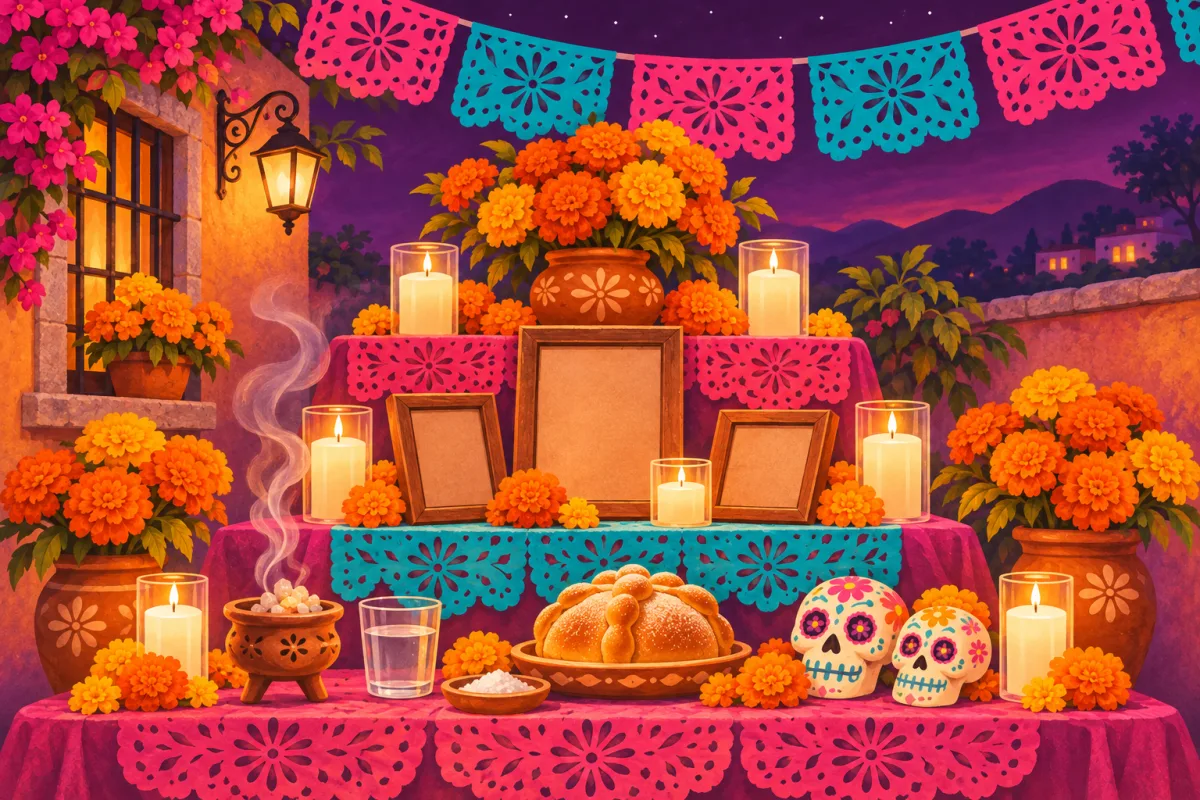
An ofrenda is not a decoration. In many communities it is prepared for relatives who, the belief goes, come back to visit. Home altars are typically set with marigold flowers, copal incense, pan de muerto, candles and sugar skulls.
Families often add photographs and objects that belonged to the person, along with the food and drink they enjoyed. Those last touches are what make an altar one person's, not anyone's.
Families may make altars for their own dead; public altars can honor a wider community. At Chicago's National Museum of Mexican Art, visitors are invited to contribute a note, drawing or memory to a community ofrenda.
What the elements mean in particular communities
Candles are among the clearest. An anthology of Indigenous communities explains that, in one community, the candle symbolizes the light that will illuminate the way of the dead.
Marigolds (cempasúchil) are arranged in different ways. Triqui altars in Oaxaca have two arches decorated with marigold or cockscomb flowers, blessed and purified with water and copal. In Santa Cruz Nundaco, also in Oaxaca, a crown of marigolds takes the place of an arch.
Water and salt appear together in Nundaco. There, water marks purification, and salt, candles and the person's favorite food are listed beside it.
In Santo Domingo Albarradas, clean water is also set outside the house, because the dead are said to bathe before they enter.
Copal also appears in the anthology's literature. In a short story narrated by a child who has died, its scent signals that he is nearing home.
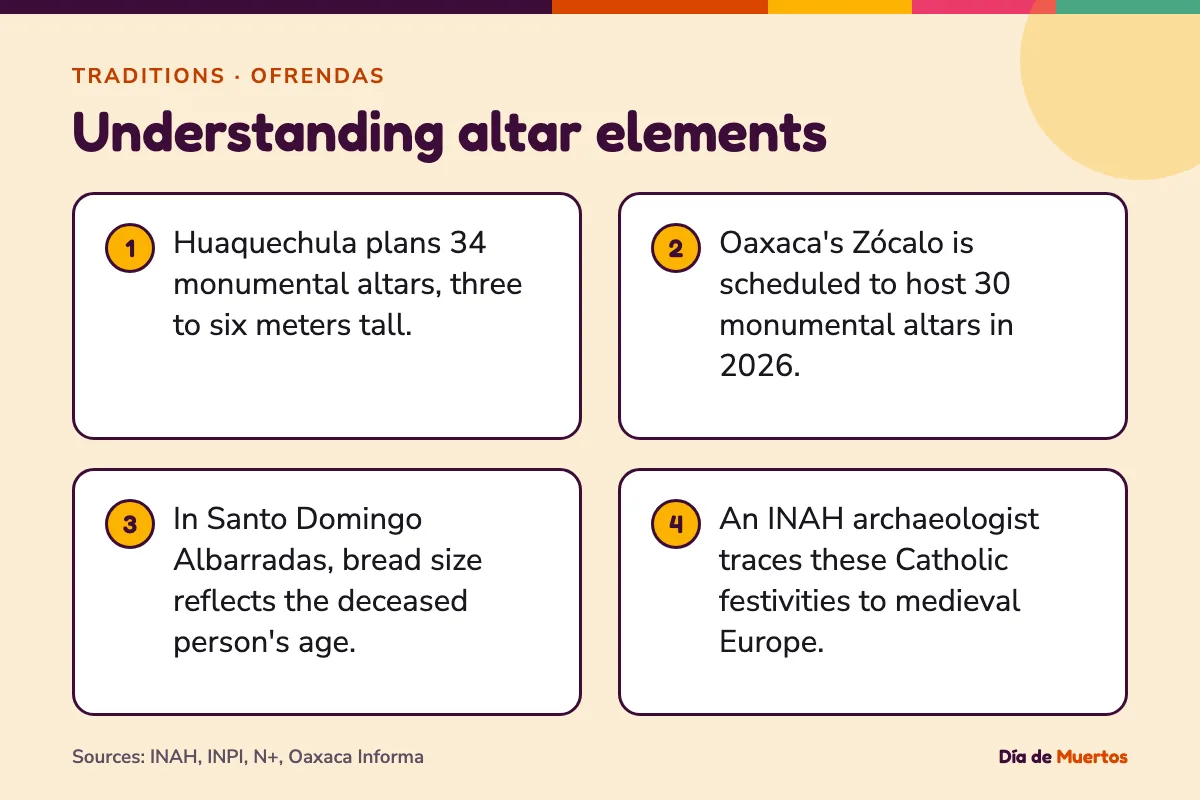
Pan de muerto can carry a code. In Santo Domingo Albarradas the bread has a face that represents the dead and comes in sizes by age: the largest for elders and adults, medium for young people, small for children.
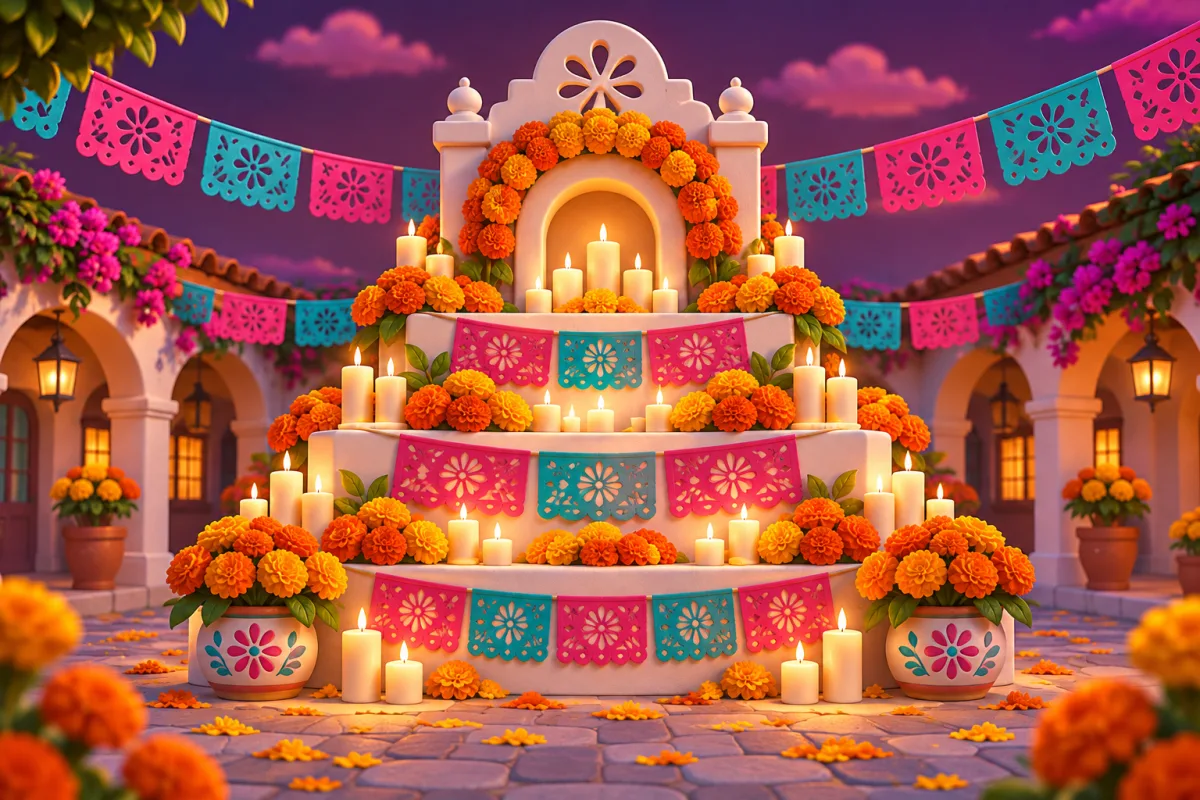
In the Mixteca, the table may be covered in a white cloth or dressed with papel picado. Some altars, as families can afford, rise in several levels that can stand for heaven, earth and the beyond.
Sugar skulls have a long history of their own. An archaeologist writing for INAH describes colonial alfeñiques, made by nuns and bought only by the wealthy, while everyone else ate sugar sweets shaped like skulls, skeletons and bones.
Two accounts of where it comes from
The idea that the festival is an ancient, unchanged Aztec rite is too simple. An archaeologist writing for INAH traces the Catholic festivities of All Saints' Day and All Souls' Day to medieval Europe and argues that older Mesoamerican funerary ceremonies were different and held on other dates.
The National Museum of Mexican Art tells it differently. It says Día de Muertos is rooted in ancient Mesoamerican beliefs and Catholicism, and has changed over centuries as each region of Mexico added its own customs.
These are two interpretations, not a final verdict. Either way, the altar you see today has been shaped by many hands over a long time.
Huaquechula: monumental altars in family homes
In Huaquechula, Puebla, 34 monumental altars of between three and six meters are planned for 2026, in homes and public spaces. Four are planned to honor people who died this year.
Puebla's state government describes the town's tradition: children's souls are received on Oct. 31 and the souls of adults who died naturally on Nov. 1, and on Nov. 2 families go to the cemetery to scent graves with copal and say goodbye. That is the usual pattern rather than a dated program.
The town's tourism director described families walking to the cemetery with holy water when the bells ring, to welcome the loved one.
After a family opens its altar to the public, the custom is to invite visitors to eat, so the dead are accompanied. These are family homes. Follow the hosts' lead, and expect that you may be asked not to enter.
Hanal Pixán and the foods of the peninsula
On the Yucatán peninsula the tradition is Hanal Pixán (also written Janal Pixán), the meal of the souls. The Secretaría de Cultura's 2021 account describes the recurring pattern, Oct. 31 to Nov. 2, not a confirmed 2026 program.
Families prepare altars for children and adults with sweets, fruit, breads, pibipollos and pibinales. Pibinales are described as buried corn.
In the Camino Real of Campeche, cemetery customs include cleaning bones kept in ossuaries and lighting a candle so the dead see their way lit. This is a family rite in a sacred space, not a sight to go and watch.
Toluca and alfeñique
In Toluca, alfeñique gives the city's seasonal fair and cultural festival its name. The city's 2026 Alfeñique fair and cultural festival runs through Nov. 2, with an announced challenge to make the world's largest alfeñique sweet.
Where to see altars in public
In Oaxaca de Juárez, the state government announced 30 monumental altars in the Zócalo for 2026, representing the 16 Indigenous peoples and the Afro-Mexican people.
In the U.S., the National Museum of Mexican Art in Pilsen, Chicago, marks its 40th annual Día de Muertos exhibition in 2026. Its page invites visitors to add a note, drawing or memory to a community ofrenda.
Before you go
At a public altar, look closely but do not touch, and keep off the offerings. Ask before photographing anyone, and do not photograph a family's altar without permission. In a home, wait to be invited, and accept that the answer may be no.
Join a community ofrenda only where the museum or organizers ask you to. For a traditional altar visit, leave costumes at home; dressing up and skull makeup are newer practices, not longstanding customs.
Public altar displays and museum shows publish their dates each fall, so check the organizer's program before you plan a visit around one.
Quick check
1. What does one community's anthology say a candle symbolizes?
2. In Santo Domingo Albarradas, what decides the size of pan de muerto?
3. After a Huaquechula family opens its altar, what do families traditionally invite visitors to do?
Questions readers ask
How are marigolds used on an altar?
What are water and salt for on an ofrenda?
Can visitors go into the monumental altars in Huaquechula?
Sources
- Instituto Nacional de Antropología e Historia (INAH): El origen del Día de Muertos
- Instituto Nacional de los Pueblos Indígenas (INPI): Antología: Día de Muertos en los pueblos indígenas de México
- Gobierno del Estado de Puebla: Altares monumentales, símbolo de fe y tradición viva en Huaquechula
- N+: Colocarán Más de 30 Altares Monumentales por Día de Muertos en Huaquechula, Puebla
- Secretaría de Cultura (Gobierno de México): Pervive la celebración del Janal Pixán en los cementerios del Camino Real de Campeche
- Ayuntamiento de Toluca: Suma Toluca a Caifanes, La Adictiva, 31 Minutos y la Sonora Santanera a la Feria y Festival Cultural Alfeñique 2026
- MexCulture (Mano a Mano): Sobre el Día de Muertos
- National Museum of Mexican Art: Where Memory Lives
- Oaxaca Informa: Oaxaca alista altares y comparsas 2026