Hanal Pixán, also written Janal Pixán or U janal pixano'ob, is the Yucatán peninsula's Day of the Dead. The name means food of the souls, and it tells you where to look: at the table, where families set out a meal for those who have died.
The family table is not a visitor attraction. For a public introduction, Mérida's announced 2026 program offers a food fair, an explained altar and the Paseo de las Ánimas.
What Janal Pixán means
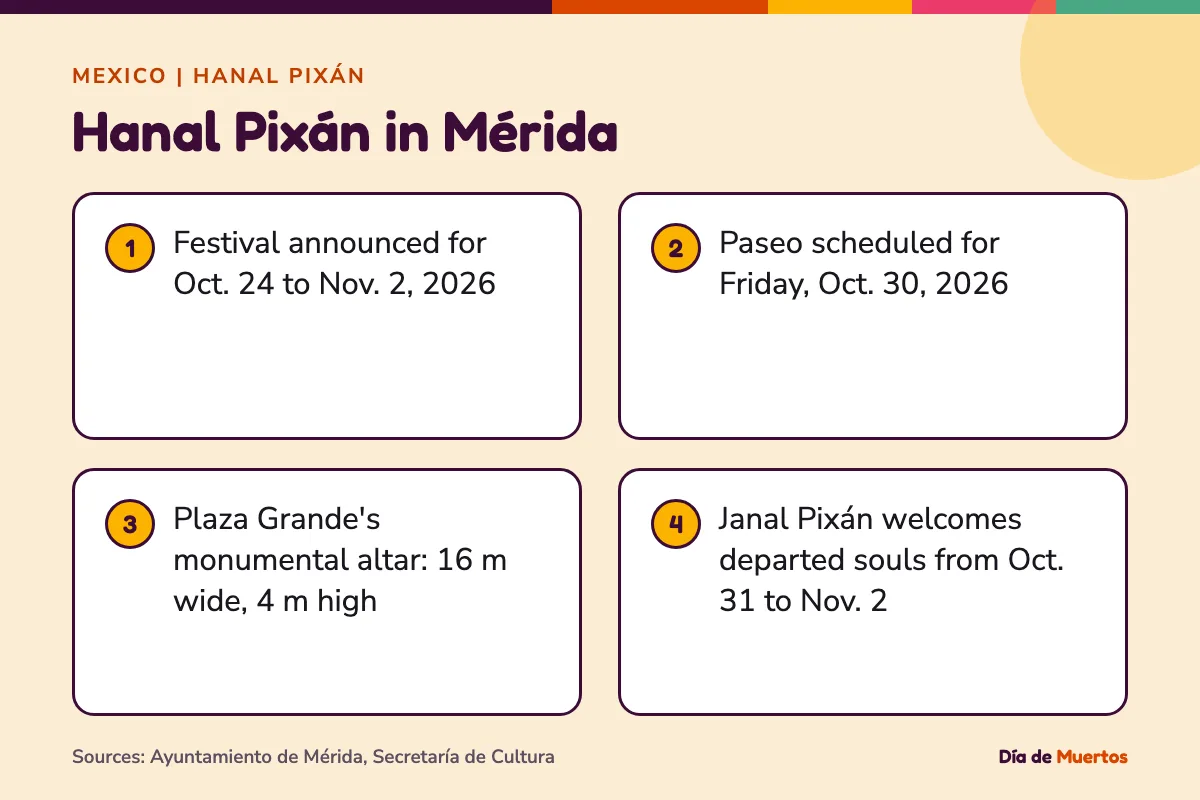
The tradition is counted among the most deeply rooted funerary customs of the peninsula. It centers on the meeting of the living and the dead from Oct. 31 to Nov. 2, as families get ready to receive the pixanes, the souls of the departed.
Another way to express the name is the meal of the souls. In Campeche it is kept in the Chenes and Camino Real regions, both with large Maya populations.
The family table, as described in Campeche
The details here come from the Camino Real, a group of municipalities in Campeche that includes Tenabo, Hecelchakán, Dzitbalché and Calkiní. They are not a description of every home in Yucatán.
There, preparations extend from the cemetery to the household. Men and women take different roles: cornfields and back yards are cleared, boundary walls receive white paint, and food and drink are readied for children's and adults' altars.
Families prepare these offerings in the belief that the visiting souls will enjoy sweets, fruit, breads, pibipollos and pibinales, or buried ears of corn.
When it happens
- Oct. 24 to Nov. 2, 2026Festival de las Ánimas announced for Mérida and its comisarías, with more than 30 activities
- Friday, Oct. 30, 2026Paseo de las Ánimas scheduled from the Cementerio General to the San Juan neighborhood
- Sat., Oct. 31, 2026, 8 p.m.Desfile de Catrinas; program route: Plaza Grande - La Plancha
Where the customs may come from
In the Camino Real, some communities clean the remains of the dead and change their clothing in ossuaries. A Maya connection has been suggested for this particular ancestor practice, in the small masonry shrines built in the Late Postclassic period, roughly 1200 to 1550.
In that suggested account, these ancestor practices joined Catholic customs for caring for the dead, producing a ritual tradition that continues to change.
Practices differ even within this part of Campeche. In Pomuch, embroidered cloth protects the remains inside a wooden box. In Nunkiní, the boxes are generally simpler and sometimes closed. In Ex Hacienda Santa Cruz, remains of several people may share one or more boxes. In Tankuché, the boxes are buried again in the family grave rather than left visible.
Mérida's public festival
Mérida's city government announced the 2026 Festival de las Ánimas for Oct. 24 to Nov. 2, in the city and its comisarías, with more than 30 activities. It is a modern civic program that sits beside the old family ritual.
The announced program includes the Paseo de las Ánimas, scheduled for Friday, Oct. 30, 2026, from the Cementerio General to the San Juan neighborhood. The city's program describes it as a representation of the souls arriving among the living, based on the Maya worldview.
The listed programming includes altars along the route, a video-mapping show, a food corridor and an area for small entrepreneurs. Activities in the parks of San Juan, La Ermita and San Sebastián are listed from 6 p.m. to 11 p.m.
The Desfile de Catrinas is a separate, festive show. It is scheduled for Saturday, Oct. 31, 2026, at 8 p.m., leaving from the Plaza Grande, and the program lists it at Plaza Grande - La Plancha.
Trying the food: the Feria del Mucbipollo
If you want food more than spectacle, the program's answer is the Feria del Mucbipollo. The 2026 program lists its ninth edition, with mucbipollos made and sold alongside traditional artistic events, in the Parque de San Sebastián.
The monumental altar
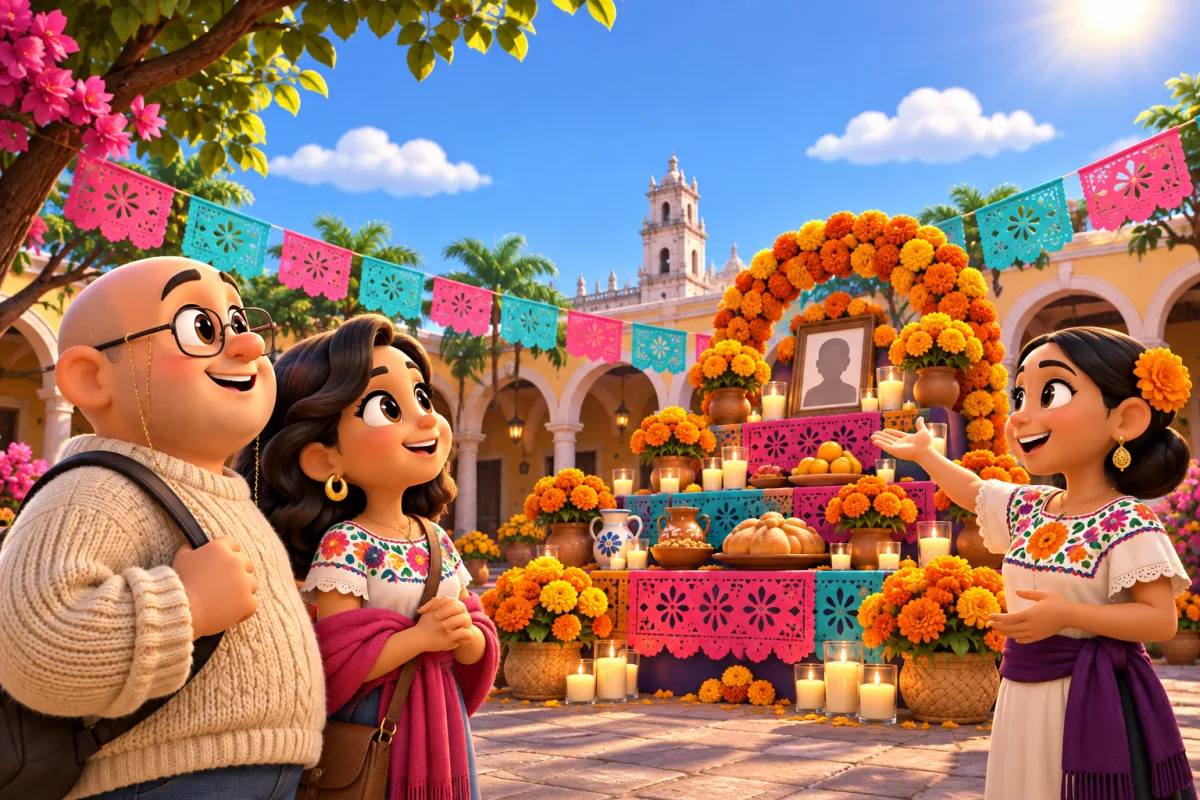
The program lists a traditional Yucatecan altar in the Plaza Grande, 16 m wide and 4 m high, dedicated to the dead. It describes an inauguration with a presentation and explanation of the altar.
A further announced activity invites tourists and residents to learn about the altar's meaning and leave offerings for their own dead.
Pomuch and the cleaning of bones
In Campeche, the tradition followed at Pomuch has become known worldwide, and the same practice is kept in other communities such as Pocboc, Nunkiní and Pucnachén.
These are private family rites, not attractions. Do not seek access unless a family invites you, and know that a community guide does not grant permission on a family's behalf.
Reaching Mérida and exploring the center
Mérida's city government listed direct flights connecting the city with 13 domestic destinations and eight international destinations. Examples included Mexico City, Monterrey and Guadalajara within Mexico, and Miami, Dallas, Houston and Toronto internationally.
For time in the historic center, the city also advertised a free guided tour called Por el corazón de Mérida.
Before you go
The Paseo, the catrinas, the mucbipollo fair and the altar are public programs made for visitors. Home altars and village cemetery rites belong to families, who may say no.
Ask before you photograph anyone or touch anything, and accept a refusal. Keep off the graves, leave the flash off and keep your voice low near a cemetery.
Program details are set by the organizer, so look at the city's official festival program and tourism information in the fall.
Questions readers ask
What does Hanal Pixán mean?
What is the Paseo de las Ánimas?
Is bone cleaning practiced only in Pomuch?
Sources
- Ayuntamiento de Mérida: Presenta Cecilia Patrón agenda cultural de Mérida para el cierre de 2026
- Ayuntamiento de Mérida: Festival de las Ánimas 2026: calendario de actividades
- Secretaría de Cultura (Gobierno de México): Pervive la celebración del Janal Pixán en los cementerios del Camino Real de Campeche
- Instituto Nacional de los Pueblos Indígenas (INPI): Antología: Día de Muertos en los pueblos indígenas de México