In Pomuch, in Campeche's Camino Real region, care for the dead continues beyond burial. The local practice of cleaning bones belongs to the wider remembrance known as Janal pixan on the Yucatán Peninsula.
Janal pixan, the meal of the souls
The names Janal pixan and U janal pixano'ob refer to a remembrance whose Spanish name, Comida de las animas, translates into English as meal of the souls. The Campeche account describes a longstanding peninsula tradition centered on welcoming the dead.
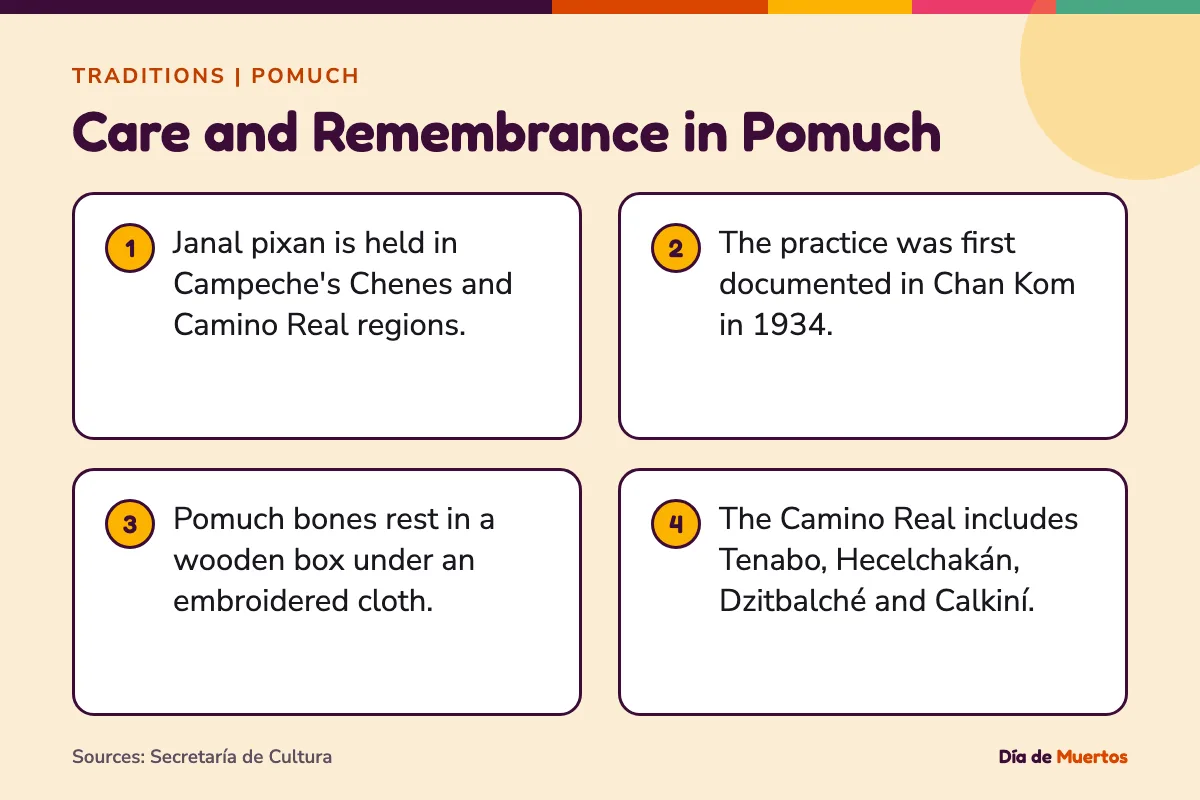
In Campeche it is observed in the Chenes and Camino Real regions, both with a significant Maya population. The account describes its heart as a reunion: families prepare to receive the pixanes, or souls of their departed.
What the Camino Real accounts describe
The Camino Real covers the municipalities of Tenabo, Hecelchakán, Dzitbalché and Calkiní. Some towns there keep particular funeral customs. In the account's description, the customs include cleaning the remains and changing their clothing, and the remains are kept in ossuaries.
The account does not identify who performs this care.
In several communities, including Pocboc, Nunkiní, Ex Hacienda Santa Cruz, San Nicolás and Pucnachén, the remains go back into the ossuary after cleaning, with the box left slightly open. The account explains the accompanying candle as a light for the dead person's path.
Pomuch's embroidered cloth
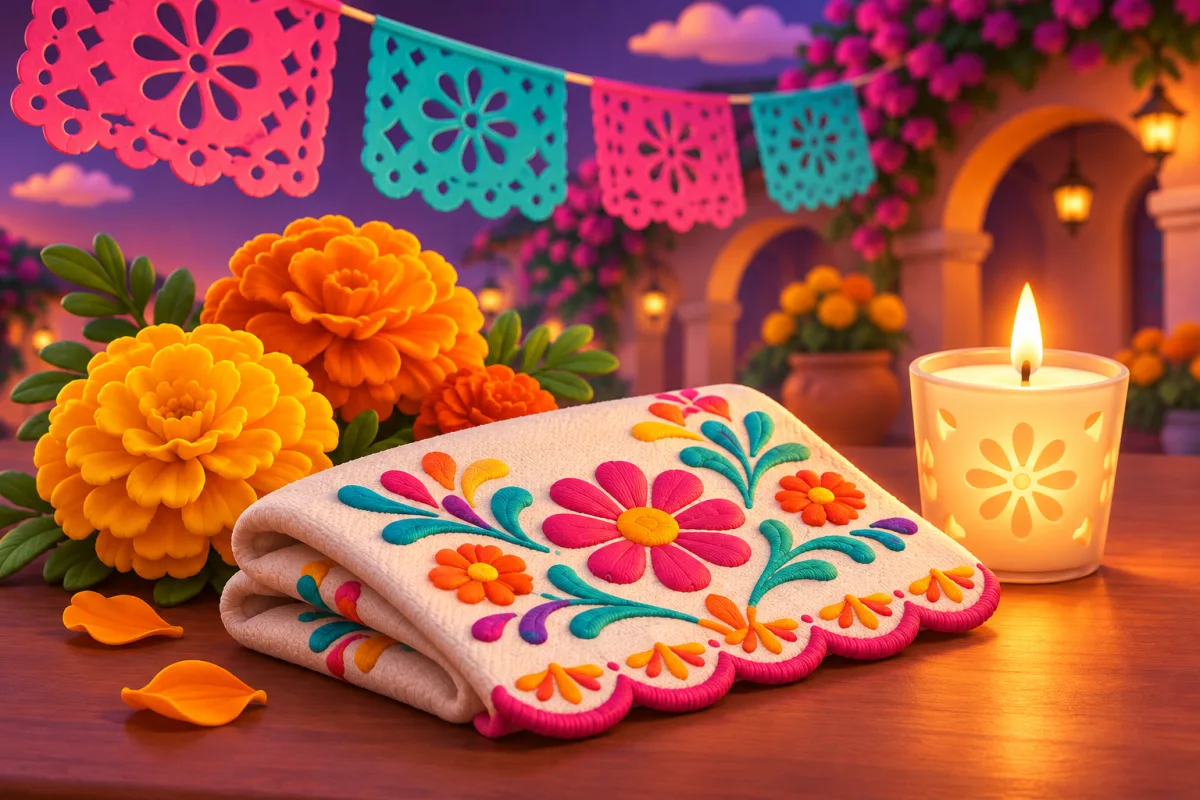
In Pomuch, the account describes a wooden box holding the bones beneath an embroidered cloth. Flowers and the remembered person's name appear in the embroidery.
Neighboring cemeteries do it differently
The account describes a range of settings. In Nunkiní the box is simply set in place and sometimes stays closed. At Ex Hacienda Santa Cruz the remains of several people are arranged in one or more boxes.
In Tankuché the small boxes are reburied in the family grave and are not left in view. San Nicolás has no niches, only open sheds with sheet-metal roofs on posts. In Pocboc the ossuaries look like small houses or churches facing east.
In larger towns such as Hecelchakán, boxes are stacked in a chapel or storerooms, where the account says they face neglect and the passing of time.
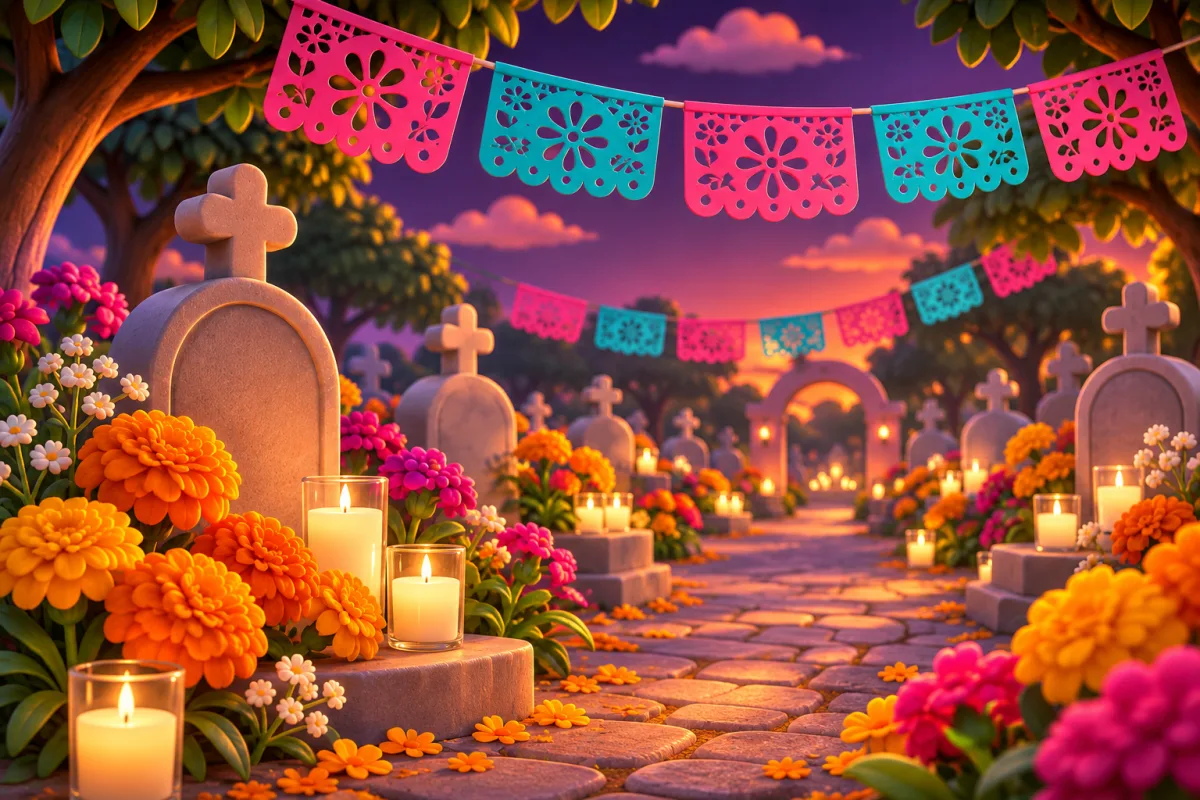
Across the region's cemeteries, the account describes a shared layout: space beside the boundary wall for ossuaries, with graves in the interior, including in newer cemeteries.
Faith, space and money
The account says these funeral treatments carry a strong symbolic and religious meaning, and it links the cleaning of bones to the Catholic ideal of resurrection.
It also points to practical causes. As populations changed, cemeteries needed to use space better, emptying older graves and moving the remains into personal, family or collective ossuaries, depending on the cemetery and the family's means.
Some graves are permanent for those who can buy them. Others are lent by the local authority for three to five years. When that period ends, the remains are taken out, cleaned and moved to an individual or family ossuary.
From the cemetery to the home
These rituals do not stay inside the cemetery walls. The household preparations described in the account involve men and women in different roles. Food and drink are made for offerings to deceased children and adults; work also includes tending milpas and backyards and giving the stone boundary walls a white finish.
The account lists sweets, fruit, bread, pibipollos and pibinales as offerings for the returning spirits. Its Spanish gloss for pibinales translates into English as buried ears of corn.
Old roots, offered tentatively
The cleaning of bones and their move to an ossuary was first documented by Robert Redfield and Alfonso Villa Rojas in 1934, in Chan Kom, Yucatán. Researchers including Vera Tiesler and Beatriz Repetto have studied it since.
The account says it has been suggested that the ancestor worship goes back to small masonry shrines built by the Maya in the Late Postclassic period (1200-1550 C.E.), and to secondary burials such as those documented at Tulum. In this interpretation, those practices combined with Catholic customs for the dead to form a ritual system that continues to change.
Other communities, other customs
The Indigenous remembrance anthology describes distinct customs in different communities. In the Ch'ol community in Campeche, the altar is decorated with xate leaves and flowers, and candles light the place.
In Santo Domingo Albarradas, Oaxaca, the bread comes in sizes that match the age of the person remembered. Among the Nahuas, objects placed beside the offering are gifts meant for other souls the dead will meet on their way.
The anthology puts it plainly: each culture has its own way of thinking about death. Pomuch's practice is not presented as one shared by all Indigenous peoples.
Before you go
Care for the dead in a cemetery is family remembrance, not a program for visitors. An open cemetery gate is not permission to watch or photograph it, and no guide, driver or host can give consent on a family's behalf. If a family says no, that settles it.
If you want to learn more in person, look to separately announced public programs, museum exhibits and markets. Before booking, check the venue's or local government's information and choose only activities explicitly announced for the public. Keep photographs of home altars and graves for the families who made them.
Quick check
1. What does the cloth over Pomuch's wooden box carry?
2. Where was the peninsula's bone-cleaning tradition first documented, in 1934?
3. In Tankuché, what happens to the small boxes?
Questions readers ask
What is the cleaning of bones in Pomuch?
Is it done only in Pomuch?
Is bone cleaning universal among Indigenous peoples?
Sources