At Tucson’s All Souls Procession, the walk leads to a public ceremony and the burning of a vessel the organizer calls the URN. The organizer describes the gathering as a funeral, with remembrance and celebration of the dead at its heart.
The urn belongs to that public ceremony. Understanding its place in the procession begins with the organizer’s description of the closing ritual, rather than with assumptions about what a ceremonial vessel might contain.
The ceremony at the end
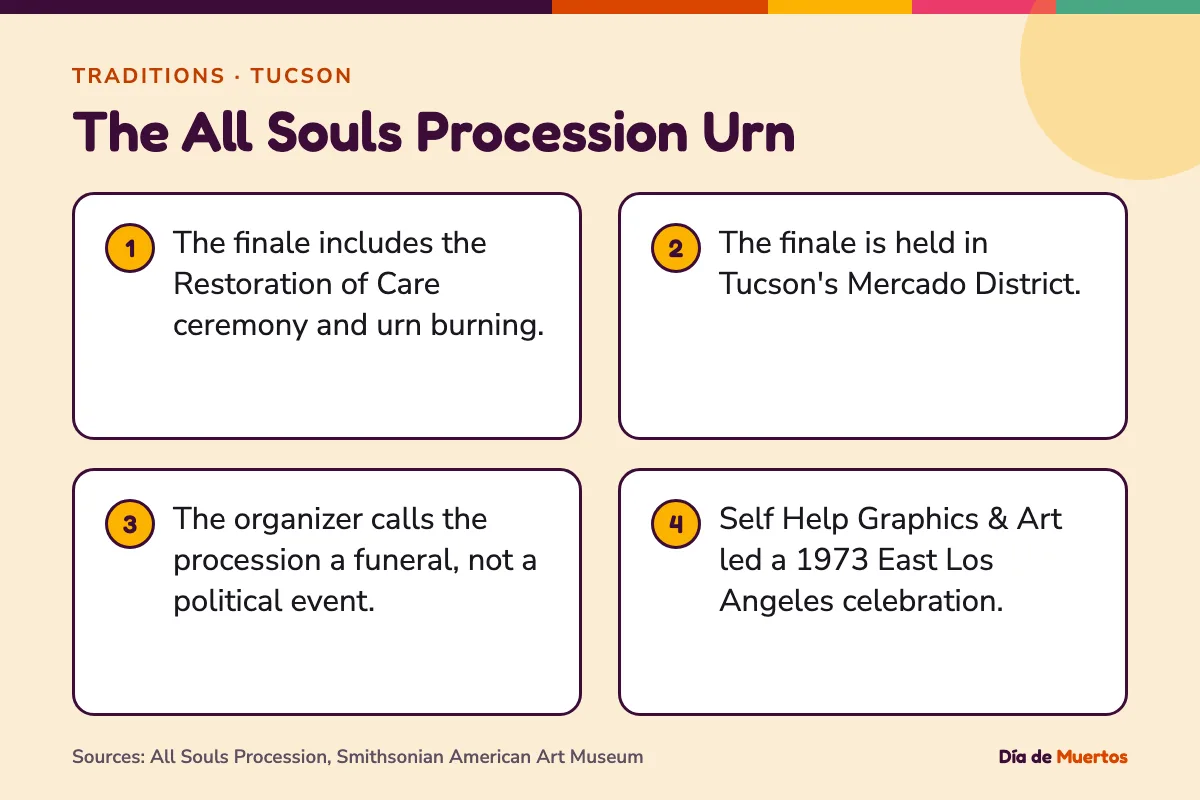
The organizer describes the procession as culminating in the “Restoration of Care” Ceremony and the burning of the urn, in Tucson’s Mercado District. In that description, the vessel’s burning belongs to the closing ceremony; it is not presented as an unrelated attraction.
The organizer’s account connects movement through Tucson’s neighborhoods with a shared ceremony at the end. Its guidelines address both the people moving along the route and those watching, with attention to neighbors, crowding and grief.
What the organizer says about the urn
The organizer’s guidelines identify the urn and name the ceremony, but give no instructions for contributing to the vessel. They do not specify what it receives or describe the handling of any contents.
An invitation to attend a public ceremony is not, by itself, an instruction to place something in the urn. Questions about contributing belong with the organizer, whose guidelines include a contact address. There is no published contribution procedure in this text to follow.
A funeral, not a spectacle
The organizer is direct about the tone. It reminds people that this is a funeral and not a political event, and it describes the purpose as honoring and celebrating those who have died.
In recalling earlier processions, the organizer describes participants bringing one another into the streets and helping with float repairs. Its account includes tears, music and objects made for both living people and those who have died. Shared creative work and grief appear together in that description.
The organizer welcomes everyone to the public ceremony. It says preparing each procession weekend involves at least a year of work, including fundraising. Artists and other contributors build the event, which the organizer describes as operating without corporate sponsors or a financial motive.
The urn’s burning sits within this account of collective work and remembrance. The guidelines also explicitly make room for grief, asking participants to allow others their own experience of mourning.
A related Tucson tradition
The All Souls Procession is a Tucson community tradition of remembrance; it should not be treated as a universal Mexican Día de Muertos rite. It has its own organizer, its own ceremony and its own vessel.
In Día de Muertos observances, families remember the dead through cemetery visits and ofrendas. These altars may hold candles, photographs, sweets and food or drink chosen for the person being remembered. The remembrance is personal even when its forms are widely shared.
Mexican immigrants’ observance of the holiday in the United States can be traced to the 1890s. Accounts of those earlier practices include Mass, flowers at family burial places and visits to cemeteries. Mexican American families have sustained intimate and religious forms of remembrance across generations; large public gatherings are not the holiday’s only expression.
During the 1970s, Chicano activists and artists developed public holiday events connected to cultural identity and Indigenous heritage. Self Help Graphics & Art led an early example in 1973 in East Los Angeles. Participants brought art, ofrendas and a parade into the celebration. At the cemetery where that parade finished, an altar remembered victims of gang violence, linking remembrance with concerns facing the community.
Community groups and arts organizations now host public observances with growing frequency around the United States. Artists have also brought altars and installations into galleries and museums, extending remembrance into cultural spaces. These developments have not displaced every household practice: many Mexican American families continue their own personal or religious observances alongside the more visible public events.
That broader history provides context for public remembrance in the United States, not a genealogy of Tucson’s urn. The East Los Angeles example concerns Día de Muertos; the All Souls Procession has its own named closing ceremony. A public setting alone does not make the two rituals interchangeable.
Before you go
The organizer asks attendees to approach the gathering as a funeral. Give others room to mourn, keep the finale entrance clear, and move toward a less crowded area if people are packed closely together. Along neighborhood streets, leave driveways unobstructed, protect flower gardens and carry away your litter.
For any visit, check the organizer’s current route and transportation information before making plans. Questions about the urn, including whether and how contributions are accepted, should go directly to the organizer rather than being answered by assumptions about other remembrance traditions.
Quick check
1. How does the organizer describe the event's tone?
2. What happens at the end of the All Souls Procession?
3. Which group led an early modern public celebration in East Los Angeles in 1973?
Questions readers ask
What is the urn at the All Souls Procession?
Is the All Souls Procession open to everyone?
Do public celebrations replace family observance in the United States?
Sources